Astralis Is Being Forced to Police Its Own Fans

From TwogPedia
News/Astralis Is Being Forced to Police Its Own Fans


Astralis Is Being Forced to Police Its Own Fans

Business

10 June 2026 07:06

A CEO, a team and fans. This is the trifecta of sports and esports. This story is about this nothing more.

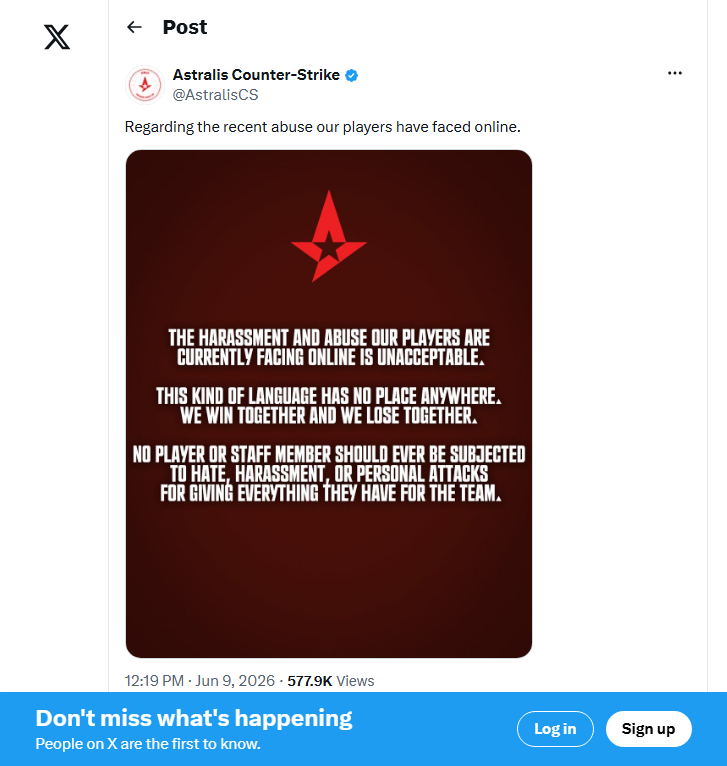
Astralis responding to the abuse of its players with a public statement, a CEO call for regulation, and a captain deleting his apps is what it looks like when an esports org is pushed into acting as a security operation against its own community. Well obviously the trigger was an early exit from the IEM Cologne Major, where Astralis went out 1-3 in Stage 2, but the response went well past the usual "we'll bounce back" messaging. The org flatly condemned the "harassment and abuse our players are currently facing online," in-game leader Rasmus "HooXi" Nielsen stepped away from social media entirely after reportedly receiving death threats, and Fusion Esports Group CEO Jonas Gundersen publicly wished for "a huge push in social media regulation and the ability to pursue legal action on online abuse."

The reason this matters beyond one bad week for a Danish team is that it fits a hardening pattern across esports, where harassment has escalated to the point that orgs are building actual infrastructure to deal with it. Gundersen's call for the ability to pursue legal action wasn't rhetorical hand-wringing, it pointed at a direction the industry is already moving, with major organisations increasingly treating online abuse as something to be tracked and litigated rather than just weathered. The logic is straightforward once you sit with it. When abuse crosses from "you're trash" into credible death threats, a condemnation tweet is useless, and the only levers with real teeth are legal ones, which means orgs now need the capacity to identify anonymous attackers and take them to court. In plain terms, teams are being forced to develop the kind of threat-response function you'd expect from a security firm, not a Counter-Strike team.

The Hard Part: The Result Genuinely Was Bad

Here's the tension that makes this difficult rather than simple, and it's worth being honest about. Atrsalis' exit wasn't unlucky, it was a genuine failure, and pretending otherwise would be dishonest. This was the org's ninth consecutive Major without reaching the playoffs since its Berlin Major win back in 2019, the run included a lopsided 13-6 loss to TYLOO, and the elimination series against paiN featured Astralis conceding a 12-0 half on the way out. HooXi himself called it an "embarrassing way to go out," which is about as candid as a captain gets. Fans have every right to be furious about that, to question the roster, the preparation, and the international project Astralis bet on.

Why "Regulation" Is the Tell

The most revealing word in the whole episode is "regulation," because it signals that orgs no longer believe the problem is solvable through community goodwill or platform moderation alone. Gundersen's framing, that without legal recourse "this spins out of control in the future," is an admission that the current tools have failed and that the abuse is structural rather than a one-off. Whether legal action against anonymous online harassers is actually practical is a genuinely open question, since attackers hide behind throwaway accounts, jurisdictions don't line up, and the cost of pursuing John Doe lawsuits is steep. But the fact that a CEO is publicly wishing for those powers, and that a captain felt his only real option was to disappear from social media, tells you where this is heading. The people who run esports teams are concluding that protecting their players now requires lawyers and policy, not just statements.

More:Astralis in Crisis

Tags: Astralis
Share:


Astralis Is Being Forced to Police Its Own Fans

Business

10 June 2026 07:06

Tags: Astralis

A CEO, a team and fans. This is the trifecta of sports and esports. This story is about this nothing more.

Astralis responding to the abuse of its players with a public statement, a CEO call for regulation, and a captain deleting his apps is what it looks like when an esports org is pushed into acting as a security operation against its own community. Well obviously the trigger was an early exit from the IEM Cologne Major, where Astralis went out 1-3 in Stage 2, but the response went well past the usual "we'll bounce back" messaging. The org flatly condemned the "harassment and abuse our players are currently facing online," in-game leader Rasmus "HooXi" Nielsen stepped away from social media entirely after reportedly receiving death threats, and Fusion Esports Group CEO Jonas Gundersen publicly wished for "a huge push in social media regulation and the ability to pursue legal action on online abuse."

The reason this matters beyond one bad week for a Danish team is that it fits a hardening pattern across esports, where harassment has escalated to the point that orgs are building actual infrastructure to deal with it. Gundersen's call for the ability to pursue legal action wasn't rhetorical hand-wringing, it pointed at a direction the industry is already moving, with major organisations increasingly treating online abuse as something to be tracked and litigated rather than just weathered. The logic is straightforward once you sit with it. When abuse crosses from "you're trash" into credible death threats, a condemnation tweet is useless, and the only levers with real teeth are legal ones, which means orgs now need the capacity to identify anonymous attackers and take them to court. In plain terms, teams are being forced to develop the kind of threat-response function you'd expect from a security firm, not a Counter-Strike team.

The Hard Part: The Result Genuinely Was Bad

Here's the tension that makes this difficult rather than simple, and it's worth being honest about. Atrsalis' exit wasn't unlucky, it was a genuine failure, and pretending otherwise would be dishonest. This was the org's ninth consecutive Major without reaching the playoffs since its Berlin Major win back in 2019, the run included a lopsided 13-6 loss to TYLOO, and the elimination series against paiN featured Astralis conceding a 12-0 half on the way out. HooXi himself called it an "embarrassing way to go out," which is about as candid as a captain gets. Fans have every right to be furious about that, to question the roster, the preparation, and the international project Astralis bet on.

Why "Regulation" Is the Tell

The most revealing word in the whole episode is "regulation," because it signals that orgs no longer believe the problem is solvable through community goodwill or platform moderation alone. Gundersen's framing, that without legal recourse "this spins out of control in the future," is an admission that the current tools have failed and that the abuse is structural rather than a one-off. Whether legal action against anonymous online harassers is actually practical is a genuinely open question, since attackers hide behind throwaway accounts, jurisdictions don't line up, and the cost of pursuing John Doe lawsuits is steep. But the fact that a CEO is publicly wishing for those powers, and that a captain felt his only real option was to disappear from social media, tells you where this is heading. The people who run esports teams are concluding that protecting their players now requires lawyers and policy, not just statements.

More:Astralis in Crisis

Share:
Sources: